
St. Elmo’s Fire
What is St. Elmo’s Fire
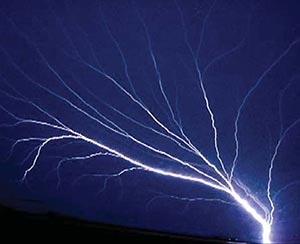
St. Elmo’s fire is defined as a phenomenon occurring in the weather when coronal discharge from a pointed object gives rise to luminous plasma. It takes place in the presence of a strong electric field in the atmosphere such as that created by an erupting volcano or a thunderstorm.
In the field of electricity, the ionization of a fluid or gas encompassing a charged conductor causes an electrical discharge, better known as a corona discharge. It occurs naturally in systems carrying high voltage, spontaneously.
St. Elmo’s Fire History
St. Erasmus of Formia had two names. One was St. Elmo and another, St. Erasmo. The name of the said phenomenon has its origin in the first of the two names mentioned above. It sometimes made its appearance as a glowing ball of light on ships during thunderstorms making sailors regard it with religious awe, resulting in the name.
Because of its electrical nature, it could interfere with readings of the compass, leading to sailors believing it to be a bad omen and an indication of stormy weather conditions. However, certain other references point out the possibility of regarding it as a good omen as testified by the presence of their patron saint in the name.
What Causes the Phenomenon
St. Elmos’s Fire is neither ball lightning, nor lightning and definitely not fire. Lightning is the passage of electricity from a charged cloud to the Earth. On the other hand, St. Elmo’s Fire is simply sparking. It resembles a shot of electrons in the air.
The prerequisite of its occurence is a thunderstorm which causes the atmosphere to gain electric charge. Since there is a high difference of charge between the ground and the storm clouds, electric pressure or voltage is formed. Then the atoms in the air undergo ionization. The electrons distance themselves from the protons and move around freely. Thus, the air becomes a good conductor of electricity leading to the creation of plasma or ionized air.
When the voltage difference between the air and any charged object becomes sufficiently high, around 30,000 volts per cm of space, the object discharges its electrical energy tearing apart air molecules. Light is emitted in the process, sometimes accompanied by a slight hissing sound. Pointed objects facilitate St. Elmo’s Fire since these surfaces can discharge at lower voltage levels. For instance, the mast of a ship, tip of an airplane wing or that of a church steeple.
The constant glow lasts for several minutes in some cases. Different gases will glow with different colors. However, since the atmosphere of the Earth has an abundance of nitrogen and oxygen, the emission is mainly of blue or violet color. Nevertheless, it can also have shades of green or pink in rarer occasions.
St. Elmo’s fire can impact any aircraft flying through heavily charged skies. While it is not a hazard as such, it is usually accompanied by rough weather and can be followed by lightning.
St Elmo’s Fire, earlier looked upon as an eerie glow by sailors at sea triggering spiritual fantasies has been rendered a proper scientific explanation by greats like Benjamin Franklin and Charles Darwin. Rather than being anything ghostly, the glow mostly occurring at the end of a storm is just static electricity in action.
-
References
Article was last reviewed on Friday, February 3, 2023
Related articles




Join our Newsletter
Fill your E-mail Address